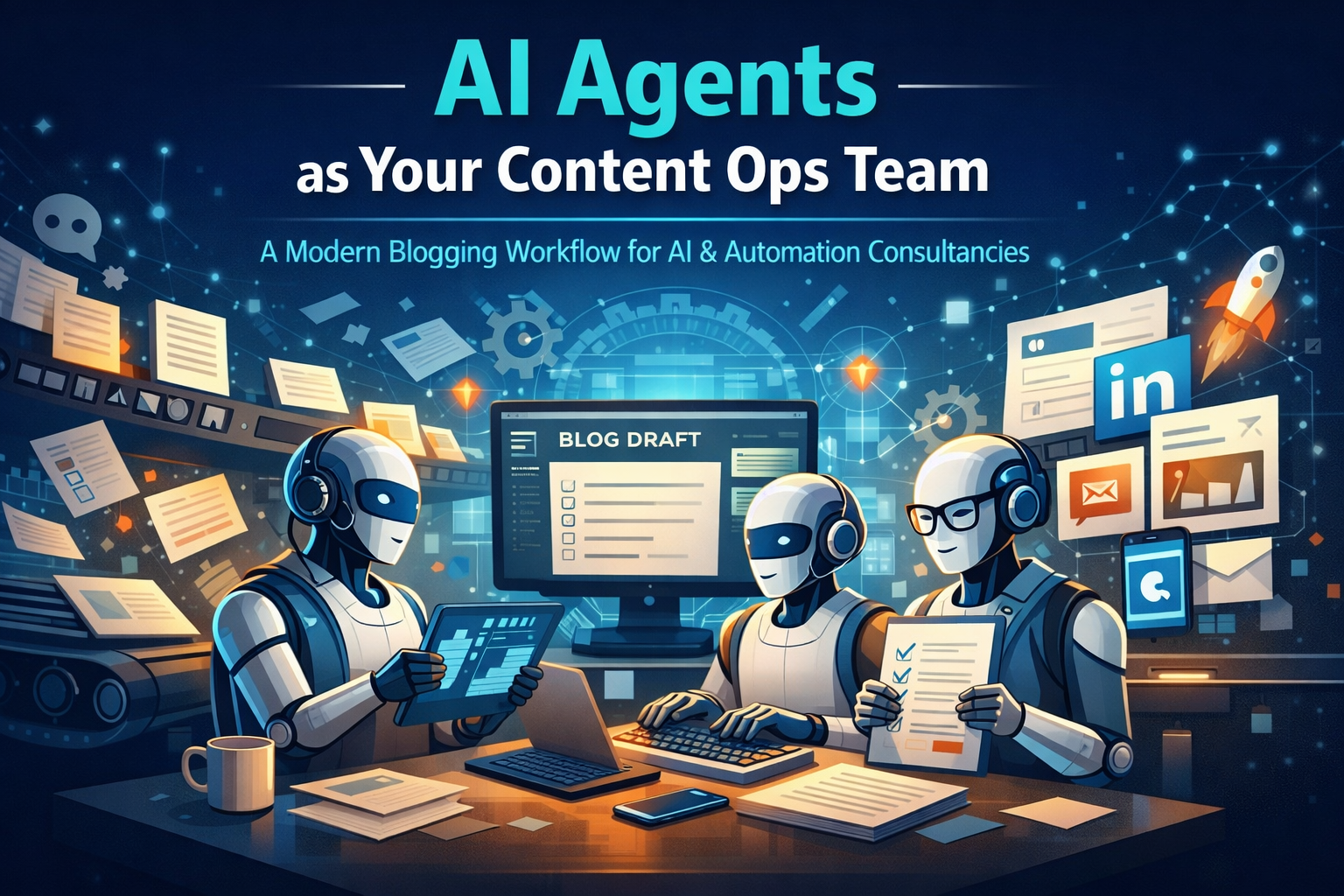
If you run an AI and automation consultancy, you already know the pattern: the best work is repeatable, measurable, and built on solid operating rhythms. Yet blogging is often treated as the opposite—an artisanal, inconsistent activity that depends on inspiration and spare time.
The fix is to treat content like any other delivery process: design a pipeline, assign roles, enforce quality gates, and automate everything that shouldn’t require senior attention. AI agents are a natural fit for this, because they’re good at transforming and packaging information—especially when the work can be broken into discrete steps with clear inputs and outputs.
Below is a practical, consultancy-ready “agentic blogging” system you can run with your team (or solo) to publish consistently without diluting your point of view.
Why classic blogging stacks feel less relevant now
Static site generators like Hugo and Jekyll were great answers to yesterday’s problems: speed, security, simple hosting, predictable builds. They’re still fine tools—but they’re increasingly less central to modern content operations for consultancies, for a few reasons:
- Distribution isn’t on your domain anymore. Most discovery happens via LinkedIn, newsletters, community posts, and search snippets. Your blog is a credibility anchor, not the only channel.
- Content is multi-format by default. A single idea should become a post, a short thread, a newsletter section, a talk outline, and a client-ready one-pager. Traditional “write Markdown → build site” workflows don’t help much with repurposing.
- Speed-to-publish matters more than build tooling. The bottleneck is not generating HTML; it’s extracting insights, shaping narrative, reviewing for accuracy, and shipping on cadence.
- Content pipelines are now automation problems. Once you treat writing as an ops process, the “site generator” becomes an implementation detail, not the organising principle.
In other words: your competitive edge isn’t how you render pages—it’s how reliably you turn real consultancy learnings into useful, credible artefacts.
The core idea: agents handle the assembly line, humans own the judgment
Think of agents as a small content ops team:
- One agent is your research assistant
- One is your drafting copywriter
- One is your editor and policy checker
- One is your publisher and repurposer
Humans stay responsible for:
- what you believe (the point of view),
- what you can prove (accuracy),
- what you can share (client safety),
- and what you want readers to do (positioning and CTA).
The result is not “AI writes your blog.” The result is you ship more of what you already know—without losing your voice.
A consultancy-grade agentic blogging pipeline
Here’s a workflow that works particularly well for AI and automation consultancies.
1) Source Ingestion Agent (turn messy inputs into clean material)
Inputs:
- workshop notes
- discovery call summaries
- project retrospectives
- internal playbooks / SOPs
- slide decks
- recorded demos or webinars (transcripts)
Outputs:
- structured notes (problem, constraints, approach, outcome)
- extracted code snippets (intact)
- extracted diagrams/tables (as assets)
- a “redaction map” (what must not be included)
Why it matters: your best content already exists—it’s just trapped in internal formats.
2) Insight Distillation Agent (find the real “post” inside the material)
This agent answers:
- What is the one thing a technical leader will care about?
- What misconception does this correct?
- What does this save: cost, time, risk, headcount, churn?
- What’s the simplest example that proves it?
Output: a one-paragraph thesis + bullets for supporting sections.
Why it matters: consultancies don’t need more words; they need sharper positioning.
3) Drafting Agent (template-bound writing, not open-ended generation)
Give the agent a strict template. For example:
- The situation (what teams face)
- The hidden cost (why it matters)
- The pattern (how to think about it)
- A concrete workflow (steps + decision points)
- Common failure modes (what breaks in reality)
- Implementation notes (tools, integration, governance)
- Checklist (actionable takeaways)
- CTA (offer a diagnostic / workshop / teardown)
Output: a full draft that’s structurally sound.
Why it matters: templates create consistency and make editing fast.
4) Editorial & Risk Agent (credibility and compliance guardrails)
This agent is the difference between “content” and “thought leadership.”
It checks for:
- unsupported claims (“guarantees,” “X% improvement” without data)
- security/privacy issues (client identifiers, internal systems)
- overconfident language about AI reliability
- missing tradeoffs (cost, latency, evaluation, monitoring)
- vague jargon (“agentic” without explanation)
Output: a marked-up draft with specific flags and suggested rewrites.
5) Publishing & Repurposing Agent (turn one idea into five assets)
From the approved post, generate:
- 1–2 LinkedIn posts (different angles)
- a short newsletter block
- a “client-ready” one-pager summary
- a talk outline (10 minutes)
- SEO metadata (title variants, meta description, FAQ)
Output: ready-to-paste assets plus a simple posting schedule.
Why it matters: distribution is the game; your blog is the anchor.
The content topics that work best for AI & automation consultancies
Agentic systems shine when you’re converting real delivery knowledge into reusable insights. High-performing categories:
“Automation pattern” posts
Examples:
- approvals and exception handling
- human-in-the-loop design
- where RPA fits vs API automation vs agents
- monitoring and evaluation in production automations
“From zero to production” implementation guides
- how to run a 2-week automation discovery sprint
- how to measure ROI honestly (and avoid vanity metrics)
- governance: access control, logging, auditability, escalation paths
“What we learned” field notes (client-safe)
Not “Client X did Y,” but:
- what teams underestimate
- what breaks in real environments
- what changed the outcome
Decision memos
- build vs buy
- when to use retrieval (RAG) and when not to
- cost/latency tradeoffs that actually matter
A simple MVP you can implement this week
You don’t need a big system to start. Here’s a lightweight rollout:
- Pick one source you already have (a project retro, a deck, or a transcript).
- Run a distillation prompt to extract the thesis and outline.
- Generate a draft using a fixed template.
- Run an editorial/risk pass.
- Publish + repurpose into two distribution channels.
Repeat weekly. Improve the prompts and templates based on what you learned.
Within a month, you’ll have:
- a consistent cadence,
- reusable templates,
- and a content backlog derived from real work (your strongest advantage).
The point of view to lead with
Modern consultancy blogging isn’t about the site generator, the theme, or the markdown pipeline. Hugo and Jekyll aren’t “bad”—they’re just not where the leverage is anymore.
The leverage is in a content operating system:
- sourcing from delivery work,
- standardising structure,
- automating repurposing,
- and enforcing quality gates.
That’s exactly the kind of system AI agents are good at supporting—because they’re tireless at transformation and formatting, while humans stay responsible for truth and strategy.